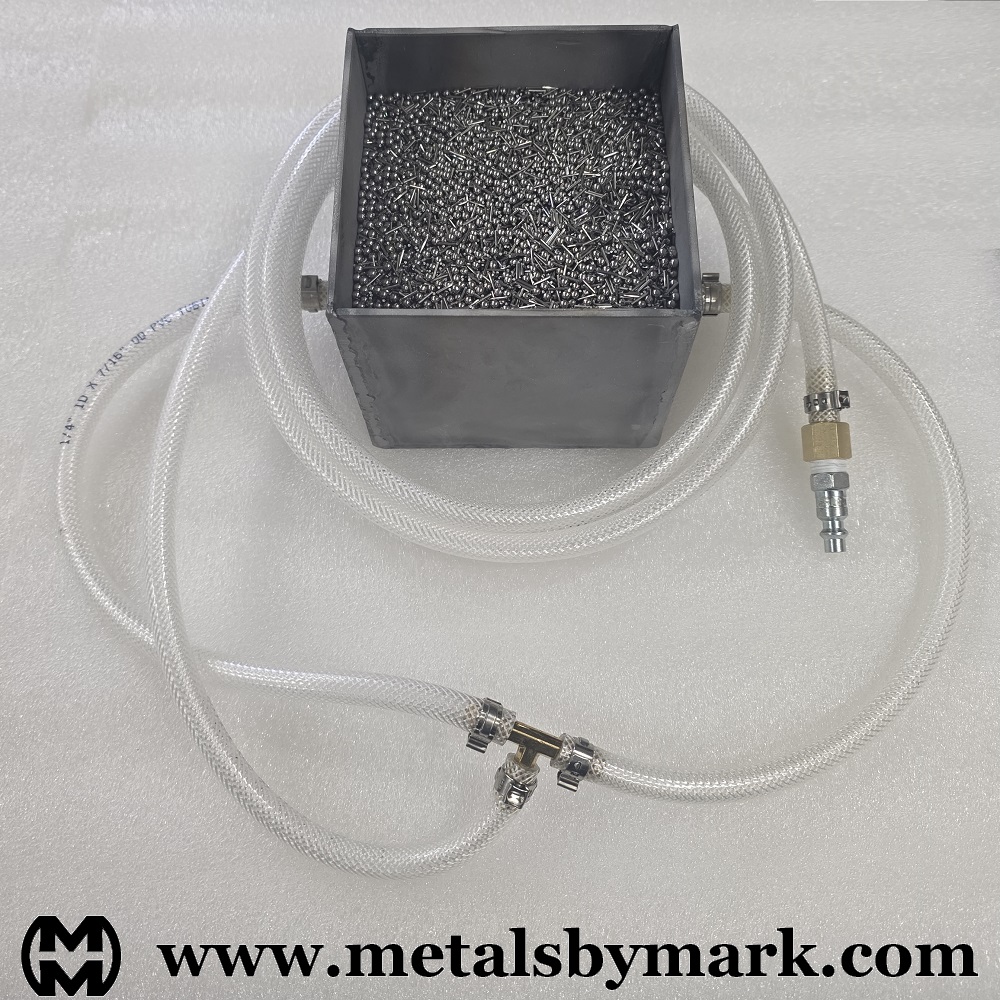
Finished box
Full of sh*t
Categories: Jewelry; Projects and equipment
Word count/read time: 518 words; 2 minutes
Precious metals are great to work with. When it comes to welding and soldering,
they are a dream. Fine silver and select other silver alloys can be flame welded
in open air. Ditto for platinum and some gold. Worst case, they can be soldered
with minimal fuss.
It's all about their physical properties. Most can withstand high heat without
oxidizing - oxides are quickly removed with a pickle solution.
If not, a quick dip in flux
will protect the surfaces as they are heated. The flux also helps solder flow
properly.
There's a group of metals called refractory metals
that can withstand high heat, primarily due to their
insane melting temperatures. The main five are tungsten, molybdenum, tantalum, niobium,
and rhenium though there are others that are referenced as such (zirconium, for instance).
Just because they can withstand high heat doesn't mean they come out unscathed.
Some can be attacked by air well below their melting temperature.
Nothing aside from an inert gas atmosphere
will protect them. Argon is the best all around but sometimes nitrogen or a mix
works. Or a complete vacuum.
Soldering refractory metals is not possible in a jewelry workshop. Welding is
usually done in a vacuum chamber with lasers or other high-tech welding processes.
TIG welding works provided it is in a sealed chamber full of argon.
It's not practical to melt refractory metals unless it's your business, i.e. ridiculously
expensive furnaces. TIG should do small amounts.
My tantalum and zirconium rings start as tubes or bars that I machine and forge into shape.
That leaves me at the mercy of finding appropriate
sizes, which limits my production capabilities and creates much waste.
While expensive to purchase in tubes or bars, the scrap isn't that valuable.
To ensure I can make
any size ring of any thickness and width without using tubes and bars, I need to start with a sheet,
cut a strip, machine it to specs, and weld the ends together.
Which brings me to the point.
I'm not spending thousands on a vacuum chamber or furnace, commercial purge box, or new
welder. If I start selling refractory jewelry like hotcakes
then I can revisit the $3k question. Until then, a simple desktop design may do the trick.
A removable, perforated platform keeps the stainless shot from filling the whole box if needed.
The shot acts as the ground and helps support the workpiece.
I will probably need carbon or other dowels to elevate the workpiece
since stainless melts at a far lower temperature and will contaminate the weld.
Argon floods the box prior to and during welding and comes out of the torch head so,
fingers crossed, it will create an inert atmosphere.
I doubt it will be as easy as it sounds on paper but one
video blogger has been successful.
The second goal is annealing. Again, they need an inert atmosphere
and super-high heat. Flames are unacceptable because
the gas will ruin the metal. My TIG welder might be up to the challenge. Anything larger
than a cuff bracelet might be off limits. Won't know until I try.
Posted by M: June 2, 2026
Please email any thoughts or comments regarding this post.
Comment Section
NOTE: Your comments will be included in this section
as long as they aren't illegal. This section is censor-free so show me
your intelligence or ignorance and everything in between!
|
2026
Purposeful Storage
So Many Gold Alloys
Wedding Anniversary Ring
Cabinet Maker
Rules of Engagement
Silverware as Jewelry
Wedding Kit
Yes, I Do Platinum!
Kinetic Ornaments
About That Price...
Viewer Discretion Advised
Copper Deserves Its Day
Interlocked Stackers
Boxed In
A Waste of Material
It's a Record
Crock Crack Pot
Oxyhydrogen Welder
Sizing a Ring
Ductile and Malleable, NOT!
New Jewelry Rings
Which Jewelry Metal Is Best?
My New Phone
Silver's Wild Ride
Synthetic Gemstones
Breath of Fresh Air
No More Room
Review: Commarker Titan 1
Pesky Descriptors
Top Purchases 2025
2025
2024
2023
2022
2021
2020
2019
2018
2017
2016
2015
2014
|