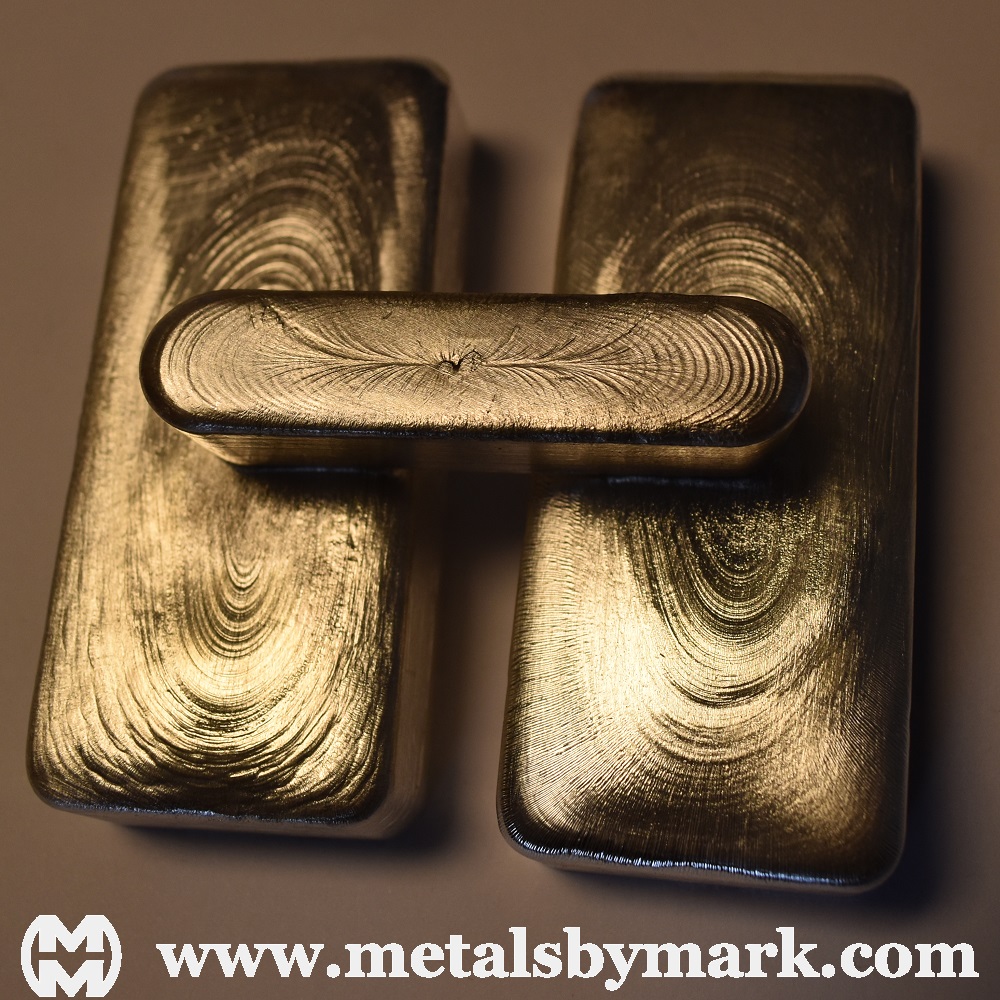
Group shot
Categories: Instruction and information; Jewelry
Word count/read time: 492 words; 2 minutes
Long before I begin making my jewelry,
the silver (or gold) goes through a remarkable transformation
that is integral to its sanctity.
After buying scrap, refining, and cleaning it, it is ready to be cast into
a usable form. Those are called ingots.
(The mother of all ingots precedes the 0.999 fine silver ones as I have
to cast what is called a dore bar for my refiner. It is a monstrous slab
to the tune of 150+ troy ounces, or 10-1/2 regular "avoirdupois" pounds
as the postal scale would say.)
Anyway, getting the refined silver shot or grain into an ingot requires melting
and pouring it into an appropriate graphite mold. Relative to the dore bar, these
pure silver ingots are smaller because large ones are unwieldly to work with it.
If I need a larger singular ingot, I can weld two together. That makes a lot
of wire or sheet.
I have ingot molds of various shapes and sizes plus a massive block of graphite
to machine new molds as needed. There are basically two
shapes. One will become wire and another, sheet.
The former is long and thin, the latter fat and wide.
It's not really important how the ingots look since they are all
going to the same place. As long as there aren't any voids and it is a cohesive piece,
it's all good. However, casting a beautiful ingot is pleasing
and not as simple as pouring molten silver into the mold. Far from it.
Eventually I'd like to sell 0.999 fine silver ingots as investment pieces.
The crowd that seeks them wants certain features. Plus, the better looking the ingot,
the better it is generally speaking. So, I strive to figure out the ideal way to cast them
into works of art.
Hand-poured ingots command a premium. They have character, something that is just not possible
from a coin or stamped bar. The highly desirable cooling lines, referred to as sycee,
are ripples that cover part or all of the top surface.
Symmetrical sycee lines are covetous. The mold has to be perfectly level.
It has to be pre-heated, ideally to glowing orange. The silver has to be at the right
temperature as it will cool tremendously fast; there is no time to waste.
The pour has to be quick and steady; aim is important (don't pee on the rim, so to speak).
The trick to getting sycee lines just right requires one more thing:
a big flame directed on the ingot during and after the pour.
This prevents the silver from solidifying too quickly,
but the flame has to be the right angle, size, and distance or it disrupts the process.
It's persnickety.
After countless hundreds of pours, I've gotten proficient at making desirable ingots.
I hesitate to transform them into manufactured products as each one is unique and
worthy of remaining intact. But I know their
new incarnation will be every bit as beautiful.
Posted by M: November 17, 2026
Please email any thoughts or comments regarding this post.
Comment Section
NOTE: Your comments will be included in this section
as long as they aren't illegal. This section is censor-free so show me
your intelligence or ignorance and everything in between!
|
2026
Beautiful Silver Ingots
Hook Clasp Revisited
In the Beginning
Purposeful Storage
So Many Gold Alloys
Wedding Anniversary Ring
Cabinet Maker
Rules of Engagement
Silverware as Jewelry
Wedding Kit
Yes, I Do Platinum!
Kinetic Ornaments
About That Price...
Viewer Discretion Advised
Copper Deserves Its Day
Interlocked Stackers
Boxed In
A Waste of Material
It's a Record
Crock Crack Pot
Oxyhydrogen Welder
Sizing a Ring
Ductile and Malleable, NOT!
New Jewelry Rings
Which Jewelry Metal Is Best?
My New Phone
Silver's Wild Ride
Synthetic Gemstones
Breath of Fresh Air
No More Room
Review: Commarker Titan 1
Pesky Descriptors
Top Purchases 2025
2025
2024
2023
2022
2021
2020
2019
2018
2017
2016
2015
2014
|